考研英语阅读:2025年考研英语一 阅读 Text 1
2025-05-04
浏览(1)
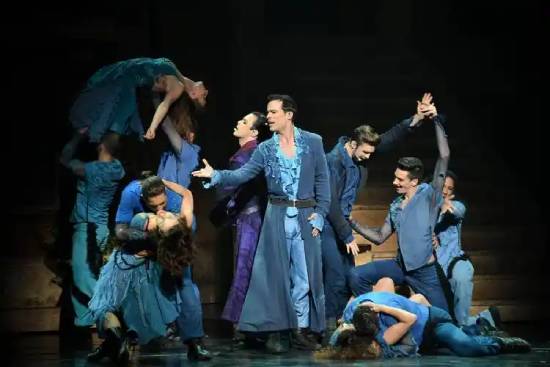
[1]The grammar school boy from Stratford-upon-Avon has landed a scholarly punch after groundbreaking research showed that Shakespeare does benefit Children's literacy and emotional development. But only if you act him out.
[2]A study found that a "rehearsal worn" approach to teaching Shakespeare broadened children's vocabulary and the complexity of their writing as well as their emotional literacy." The research shows that the way actors work makes a big difference to the way children use language and also how they think about themselves," Jacqui O'Hanlon of the Royal Shakespeare Company (RSC), which commissioned the study said.
[3]The randomised control trial involved hundreds of years pupils -aged nine and ten-at 45 state primary schools that had not been" previously exposed to RSC pedagogy." They were split into target and control groups and asked to write, for example, a message in a bottle as Fordinand after the shipwreck in The Tempest. The target group was given a 30-minute drama-based activity to accompany the passage.
[4]The peer-reviewed results showed that the target group of pupils drew on a wider vocabulary, used words “classed as more sophisticated or rarer”, and wrote at greater length. They also “appear to be more comfortable writing in role...while[control]pupils imagine how they themselves would react to being shipwrecked, [target] children put themselves in the shoes of a library character and express that character’s emotion”.
[5]The Time to Act study also found that while control pupils retied on " desert island cliche's" such as palm trees, target pupils were "more expansive giving a broader picture of the sky, the sea and the atmospheric conditions".
[6]O’Hanlon said she had been most surprised by the “emotional literacy that was evident in the [target] children’s writing and that they were “more resilient in their writing, more hopeful”. She added “The emotional understanding was very evident and it is probably related to the [rehearsal room process] where you are used to trying to imagine your way through. The were comfortable in describing different emotional states and part of what you do in drama is put yourself in different shoes”. The study showed the importance of embedding arts in education, she said.
[7]"But could the results be replicated with any old dramatist? O'Hanlon said more research would be needed but suggested that Shakespeare's use of 20000 words, compared with the everyday 2000 words, gave a “massive expansion of language into children's lives”, which was combined with children 'using their whole bodies to bring words to life'."
21.The "rehearsal room" approach requires pupils to
[A]rewrite the lines from Shakespeare.
[B] Watch RSC actors' performances.
[C]play the roles in Shakespeare.
[D] Study drama under RSC artist.
22.The study divided the pupils into two groups to find whether
[A]The change in instruction enhances learning outcomes.
[B]expanding vocabulary helps develop reading fluency.
[D] emotion affects understanding of sophisticated works.
[D]the classroom activity stimulates interest in the acts.
23. Control pupils' reliance on "desert island click’s" shows their
[A] weakness in description
[B] omission of small details.
[C]casual style of writing.
[D]preference for big words
24. what can promote children's emotional literacy according to O'Hanlon?
[A] Writing in an imaginative manner.
[B] Identifying with literary characters.
[C]Drawing inspiration from nature.
[D]Concentrating on real-life situations.
25. It can be inferred from the last paragraph that
[A]the new teaching method may work best with Shakespeare.
[B]the language of Shakespeare may be formidable for pupils.
[C] other old dramatists may be included in primary education
[D]pupils may be reluctant to work on other old dramatists.

扫码查看更详细解析
点击查看解析和答案
链接:https://wxmpurl.cn/NBBqoaGVsZj
关于

乐其英语 乐在其中