专八英语阅读:2022年专八真题 PASSAGE THREE
2025-02-19
浏览(1)
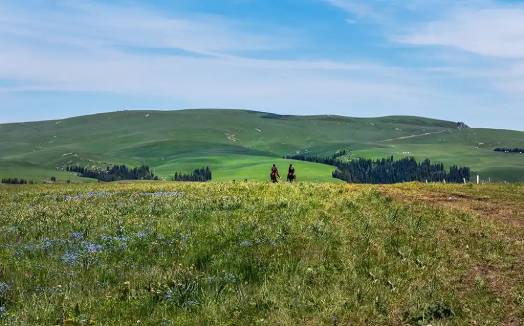
(1)Vast stretches of central Asia feel eerily uninhabited.
Fly at 30000 feet over the southern part of the former Soviet Union and there are long moments when no town or road or field is visible from your window.The landscape of stark desert, trackless steppe(大草原),and rugged mountains seems to swallow up anything human.
It is little surprise, then, that this region remains largely unknown to most archaeologists
(2)Wandering bands and tribes roamed this immense area for 5,000 years, herding goat, sheep, cattle and horses across immense steppes, through narrow valleys, and over high snowy passes.
They left occasional tombs that survived the ages, and on rare occasions settled down and built towns or even cities.
But for the most part, these peoples left behind few physical traces of their origins, beliefs or ways of life.
What we know of these nomadic pastoralists comes mainly from their periodic forays into India, the Middle East, and China where they often wreaked havoc and earned a fearsome reputation as enemies of urban life.
(3) In the past century, scholars criticized these people as destructive, dismissed them as marginal or, at best, cast them as a harsh tonic for restoring vigor to decaying and soft agricultural societies from ancient Mesopotamia to Imperial Rome to Han China.
In the 1950’s, a British archaeologist Mortimer Wheeler blamed the aggressive, chariot-driving Aryans who swept in from the steppes for the demise of their peaceful Indus River civilization after 1800 B.C., though later archaeologists dismissed that claim.
(4)But Michael Frachetti, a young archaeologist at Washington University in St.Louis, takes the radical view that ##Central Asians were early midwives in the birth of civilization## rather than a destructive force Frachetti argues that ancient pastoralists living in the third millennium B.C., at the time of the first great cities of Mesopotamia, Egypt, and the Indus, created`a network stretching across thousands of miles that passed along goods, technologies, and ideas central to urban life.
He believes they helped create civilization rather than hindering it.
(5)Most archaeological work in Central Asia during the past century has focused on the open and rolling plains that stretch from the Black Sea to Manchuria.
These steppes only came to life after 2000 B.C. when horse domestication and riding suddenly turned a forbidding landscape for pedestrians into a natural highway of grass.
(6)By contrast, the areas to the south of the steppes have long been dismissed as backwaters of history.
In the past, these southern mountains and deserts were considered too remote, rugged, and inhospitable to have played a role in early migrations or the emergence of urban life.
The Karakum Desert, where it might rain once in a decade, covers nearly two-thirds of today’s Turkmenistan, while the perpetually snow-covered Tian Shan Mountains of western China and eastern Kyrgyzstan soar 24,000 feet into the thin air.
It is there that Frachetti and a new generation of archaeologists from the United States and Central Asian nations are discovering evidence of a network of pastoralists who thrived centuries before hooves resounded on the steppes to the north These forgotten peoples may have carried such markers of civilization as ceramics and grains across thousands of miles two millennia before the Silk Road linked the Roman Empire with Han China.
Frachetti argues that the new data emerging from the region force archaeologists to rethink their ideas about trade across Eurasia during the Bronze Age, when the first civilizations were taking form to the east south and west.
(7)Frachetti, who has studied modern-day pastoralists in such unforgiving landscapes as the Sahara and Scandinavia, was drawn to the southern region of Central Asia for its environmental diversity of desert grassland, and meadows.
Instead of a wasteland, he saw an ideal landscape for enterprising herders who wanted to pasture their animals in all seasons.
Together with his colleagues, Frachetti began digging a decade ago in the Dzhungar Mountains of Kazakhstan Covering nearly 500 square miles, this region lies between the Tian Shan and Altai Mountain ranges, and boasts sharp peaks topping 12000 feet, as well as harsh desert.
At a site near a village called Begash, on a flat terrace enclosed by steep canyon walls alongside a small stream, the team uncovered the foundations of simple stone structures along with an array of potsherds(陶瓷碎片) and bronze and stone artifacts in stone-lined oval and rectangular tombs.
The earliest layers at Begash date to at least as early as 2500 B.C., based on alpha magnetic spectrometry dating of organic remains, says Frachetti.
One woman was laid to rest with a bell-shaped hooked bronze earring around 1700 B.C., according to electron spin resonance dating.
Similar earrings are only found several centuries later some 600 miles to the north on the Siberian steppes, hinting at styles that moved north over time.
(8)More surprisingly, the excavators found wheat, which was first domesticated in the Fertile Crescent of the Middle East,and broomcorn millet that was first widely grown in northern China The grains were used ritually in a burial, and radiocarbon dating of the remains dates them to about 2200 B.C.,making them the oldest known domesticated grains in Central Asia.
The people of Begash may not have grown either grain -there are no grinding stones, a sign of grain preparation - but instead received it via trade networks stretching from the Near East to China
(9) Dorian Fuller, a leading expert in ancient grains based at University College London, calls the finds“important and well dated.” He adds that Chinese crops such as millet began to appear in southwest Asia around 1900 B.C., a few centuries after they reached Begash, which could mean the passage through the mountain regions was a means of gradual transmission from east to west.
Frachetti speculates that the grains may have been acquired from other tribes and used for ritual purposes, and then perhaps were passed on in turn to other pastoral peoples.
(10) What makes the Begash discoveries so important is that previously this region was assumed to have been a land of scattered foragers(狩猎者) until steppe peoples trickled down into the area’s valleys and mountain ranges after 2000 B.C.
But it is becoming evident that the people of Begash were not simple foragers, but sophisticated pastoralists who tended their flocks, much as people in the area still do today The inhabitants did not begin to use horses until well into the second millennium B.C., and the varieties of sheep and goat found here today appear to be related to the varieties first domesticated thousands of years before in western Iran, near ancient Mesopotamia.
This indicates that Begash was “at the crossroads of extremely wide networks among Eurasian communities by the third millennium B.C.,”asserts Frachetti.
That doesn’t mean that traders traversed thousands of miles in this early period.
Instead the archaeologist envisions pastoralists taking their flocks to higher pastures in the summer, where they encountered neighbors from other valleys doing the same.Thus ideas and technologies might have passed gradually through the mountain corridors of southern Central Asia.
This corridor, Frachetti believes, may have been a key conduit for Bronze Age developments farther into East Asia and Mongolia.
20. According to Paras. 1 &2, the nomadic pastoralists were depicted as ___ people.
A peace-loving
B.mysterious
C.urban
D.friendly
21. According to the passage, what made the steppes accessible to travelers?
A. Climate change.
B. Emergence of towns.
C. Horse domestication.
D. Population movement.
22.Frachetti was initially interested in the areas to the south of the steppes because of ___
A.their varied geographical features
B. their harsh climate and terrain
C. their role in the emergence of urban life
D. their location in the trade route to the north
23. Which of the following statements about the wheat and millet found in Begash is CORRECT?
A They were early signs of agriculture there.
B. They were the result of trading with China
C. They were mainly used in religious rituals.
D. They were probably given by other tribes.
24. What is the significance of the Begash discoveries according to Para. 10?
A. People in the area lived basically as hunters.
B. New views about the region came into being.
C.Begash was at the center of the trading network.
D. Begash was part of the Eurasian community
30.What does the statement“Central Asians were early midwives in the birth of civilization” mean in Para. 4?
31.What examples are used to illustrate the harsh environment in the south of the steppes in Para. 6?
32. What did the discovery of the earrings in the tombs and those found later indicate (Para 7)?

扫码查看更详细解析
点击查看解析和答案
链接:https://wxmpurl.cn/qAJb01zQYpq
关于

乐其英语 乐在其中