考研英语阅读:2024年考研英语研一 Text 1
2024-08-17
浏览(1)
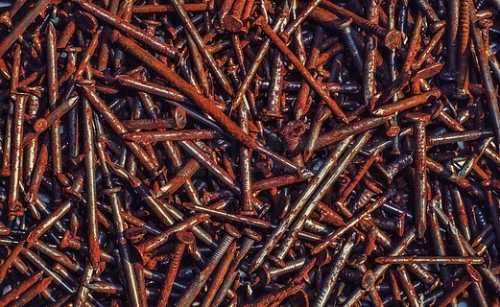
[1]Nearly 2000 years ago, as the Romans began to pull out of Scotland, they left behind a curious treasure:10 tons of nails, nearly a million of the things.
The nail hoard was discovered in 1960 in a four- metre-deep pit covered by two metres of gravel.
[2]Why had the Romans buried a million nails? The likely explanation is that the withdrawal was rushed, and they didn't want the local Caledonians getting their hands on 10 tons of weapons grade iron.
The Romans buried the nails so deep that they would not be discovered for almost two millennia,
[3]Later civilizations would value the skilled blacksmith's labour in a nail even more than the raw material.
As Roma Agrawal explains in her new delightful book Nuts and Bolts, early 17th-century Virginians would sometimes burn down their homes if they were planning to relocate.
This was an attempt to recover the valuable nails, which could be reused after sifting the ashes.
The idea that one might burn down an entire house just to reclaim the nails underlines how scarce, costly and valuable the simple-seeming technology was.
[4]The price of nails fell by 90% between the late 1700s and mid-1900s, as economist Daniel Sichel points out in a research paper.According to Sichel, although the falling price of nails was driven partly by cheaper iron and cheaper energy, most of the credit goes to nail manufacturers who simply found more efficient ways to turn steel into nails.
[5]Nails themselves have changed over the years.
but Sichel studied them because they haven't clanged much.
Roman lamps and Roman chariots are very different from LED strips and sports cars, but Roman nails are still clearly nails.
It would be absurd to try to track the changing price of sports cars since 1695, but to ask the same question of nails makes perfect sense.
[6]I make no apology for being obsessed by a particular feature of everyday objects: their price.
I am an economist, after all.
After writing two books about the history of inventions, one thing I've learnt is that while it is the enchantingly sophisticated technologies that get all the hype, it's the cheap technologies that change the world.
[7]The Gutenberg printing press transformed civilisation not by changing the nature of writing but by changing is cost - and it would have achieved limit without a parallel collapse in the paper of surfaces to write on, thanks to an with oven looked technology called apor Solar panels had a few niche uses until they became cheap; now they are transforming the global energy system.
21.Romans buried the nails probably for the sake of ___ .
[A] saving them for future use
[B] keeping them from rusting
[C] letting them grew in value
[D] hiding them from locals
22.The example of early 17th-century Virginians is used to ___ .
[A] highlight the thriftiness of early American colonists
[B] illustrate the high status of blacksmiths in that period
[C] contrast the attitudes of different civilizations toward nails
[D] show the preciousness of nail-making technology at that time
23.What played the major role in lowering the price of nail after the late 1700?
[A] Increased productivity
[B] wider use of new energies
[C]Fierce market competition
[D] reduced cost of raw material
24.It can be learned from Paragraph 5 that nails ___ .
[A] have undergone many technological improvements
[B] have remained basically the same since Roman times
[C] are less studied than other everyday product
[D] are one of the world's most significant inventions
25.Which of the following one best summaries the last 2 paragraphs?
[A] cheap technologies bring about revolutionary change
[B] technological innovation is integral to economic success
[C] technology defines people's understanding of the world
[D] Sophisticated technology developed small inventions

扫码查看更详细解析
点击查看解析和答案
链接:https://wxmpurl.cn/Ze0Cg5x3rMc
关于

乐其英语 乐在其中